
The Forward-Deployed Engineer Is the New Management Consultant
Except this time, they ship production systems

It is midnight inside a Fortune 500 data center.
A booking platform just launched its first AI agent. The demo worked perfectly. Three weeks into production, the agent is giving wrong answers because its knowledge base is not syncing with the data layer underneath it.
The company does not call their software vendor’s support line. They call their Forward Deployed Engineer, the person Salesforce embedded inside their team when the contract was signed.
Within a week, the FDE has diagnosed the integration failure, fixed the sync issue, and shipped a patch to production.
This is not a support story. It is a product strategy story.
And it is playing out at every serious AI company in the world right now.
The SaaS Assumption That AI Broke
For thirty years, enterprise software operated on a single elegant premise.
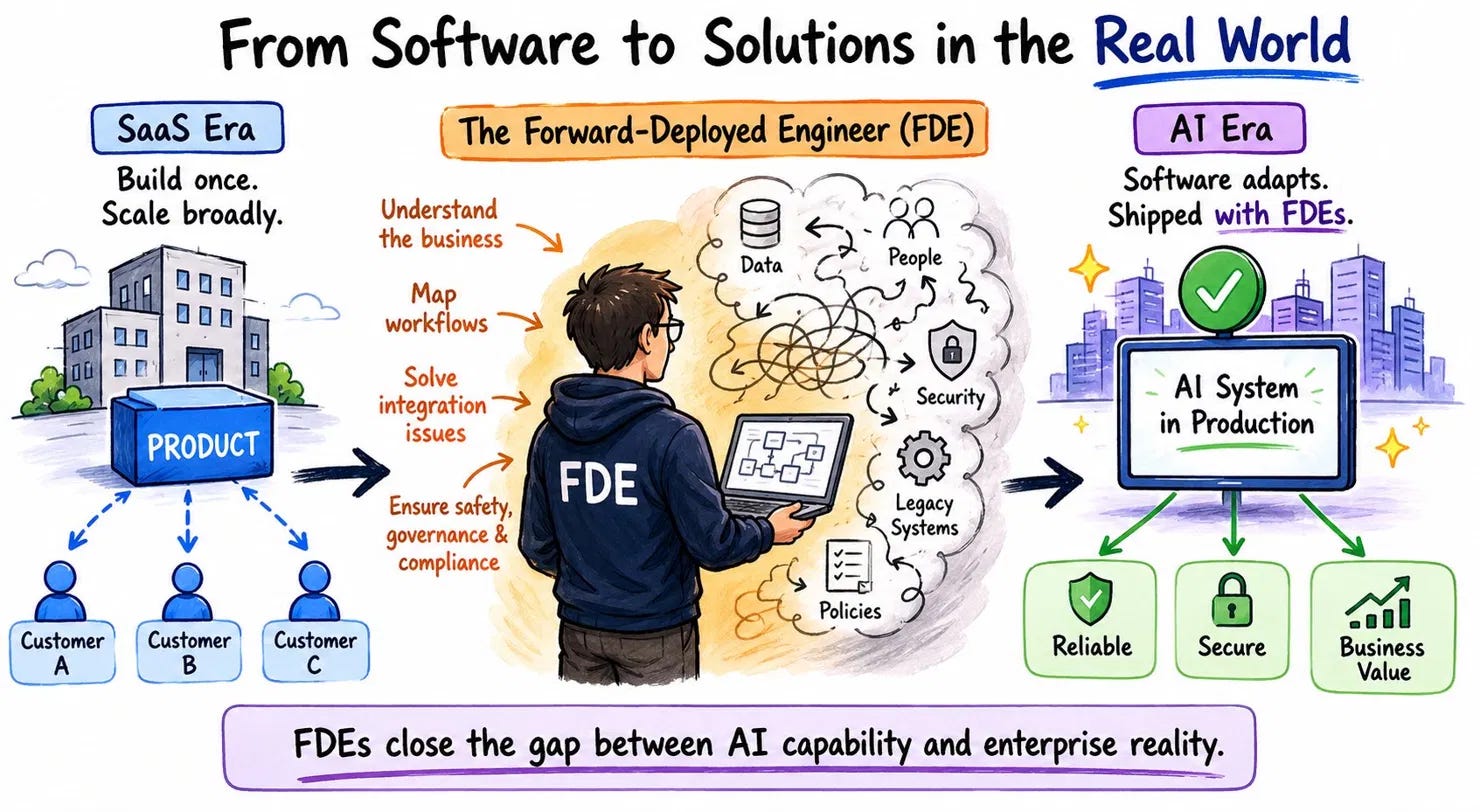
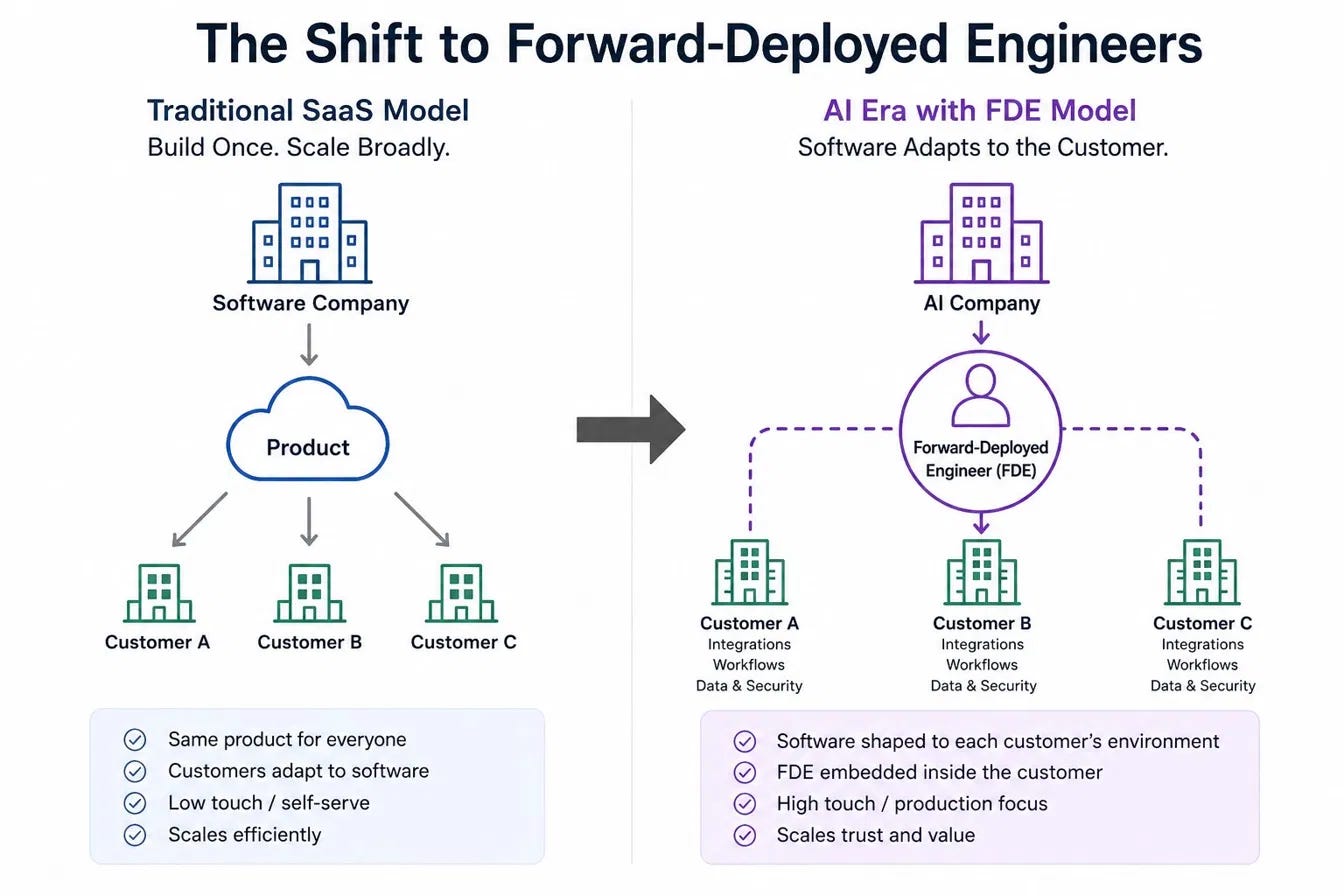
Build once. Scale broadly. The customer adapts to the software.
Salesforce did not send engineers to every law firm that bought Sales Cloud. Oracle did not embed architects inside every bank running their ERP. The product was the product. The customer figured it out.
SaaS perfected this model. Low marginal cost per new customer. High gross margins. Predictable revenue. The best SaaS business was one where customers barely needed to talk to you.
AI broke that assumption.
Not because AI models are bad. Because AI models are general, and enterprise workflows are specific. Context matters. Integration matters. Data quality matters. Governance matters. None of those things live inside the model. They live inside the customer’s environment.
An AI deployment becomes valuable only when it deeply understands company-specific workflows, internal knowledge, security boundaries, approval chains, and organizational context that no product team can anticipate from headquarters.
Traditional SaaS scaled because customers adapted to software.
AI scales when software adapts to customers.
That single inversion changes everything downstream: org structures, PM roles, go-to-market, pricing, and most importantly, who gets hired. We explored what happens to organizations when execution becomes cheap but coordination does not keep up. The FDE is the enterprise’s answer to that exact problem at the deployment layer.
Why AI Companies Suddenly Need Humans Again
For years, software companies tried to reduce human involvement in deployment. Self-serve onboarding. Product-led growth. Automated support. The goal was to make implementation disappear.
AI reverses that logic entirely.
Because the hardest problem is not model intelligence anymore. It is organizational translation.
A model can summarize documents. But can it navigate your approval hierarchy? Can it distinguish between sensitive and non-sensitive data? Can it understand why your finance team bypasses the official workflow every quarter-end? Can it operate safely across systems nobody fully documented?
That is where Forward Deployed Engineers enter.
The FDE translates between models and workflows, AI capability and enterprise reality, demos and production systems, autonomy and governance. They sit somewhere between engineer, solutions architect, product manager, consultant, and implementation lead, which is why the role is so difficult to categorize.
It is not replacing one job. It is absorbing parts of several.
The Role Nobody Expected to Matter This Much
Palantir invented the FDE model in the early 2000s not by design, but by necessity.
Their customers were intelligence agencies. These organizations could not openly explain what they needed. They could not share data freely. Their workflows changed constantly. Requirements gathering, phased rollouts, offshore development, the entire standard enterprise software playbook was structurally incompatible with their reality.
So Palantir did something unusual. Instead of asking customers what they wanted, they put engineers directly inside customer environments. These engineers learned by observing, experimenting, and building in real time, under the same constraints the customer operated under every day.
For nearly two decades, Silicon Valley dismissed this model as unscalable. Expensive. Weird. Something only a defense contractor working with intelligence agencies would bother with.
Then 2025 happened.
According to Indeed data reported by Business Insider, FDE job postings grew 729% year over year, from 643 listings in April 2025 to 5,330 by April 2026. Salaries are ranging from $170,000 to over $300,000 depending on seniority and company stage. And every serious AI company is now copying Palantir’s playbook.
Salesforce built an entire FDE organization around Agentforce and launched an FDE Partner Network with Accenture, Deloitte, PwC, Slalom, and IBM Consulting, giving 30-plus firms access to internal FDE training and product roadmap insights.
OpenAI formalized the model at scale in May 2026, announcing “The Deployment Company”, a $4 billion joint venture with 19 investors including TPG, Bain Capital, Brookfield, and McKinsey. To staff it, they acquired Tomoro, a 150-person AI deployment engineering team.
Anthropic launched a parallel $1.5 billion joint venture the same week, backed by Blackstone, Hellman and Friedman, and Goldman Sachs, with engineers embedded directly inside portfolio companies.
Google, EY, Adobe, Ramp, Scale AI, Databricks are all running variations of the same model.
Two of the most valuable AI companies in the world announced billion-dollar FDE ventures within days of each other, with zero investor overlap between them. That is not coincidence. That is the market confirming a structural shift.
Palantir itself has returned over 524% in five years, with its FDE-driven enterprise model increasingly cited as the playbook others are now following.
They Are Not Scaling Intelligence. They Are Scaling Trust.
Here is what most FDE coverage misses.
FDEs are not appearing because AI models got smarter. They are appearing because AI systems become dangerous the moment they touch real enterprise operations without proper grounding.
A demo environment is controlled. Production is where things break.
Production means identity systems, permissions, compliance requirements, sensitive data, undocumented dependencies, approval flows, audit trails, and operational exceptions that exist for reasons nobody wrote down.
The AI industry spent two years obsessing over model capability. Enterprises are now discovering that capability without operational embedding creates chaos, and liability.
This is exactly why, according to IDC research in partnership with Lenovo, reported by CIO.com, 88% of AI pilots never make it to production. For every 33 proofs of concept a company launches, only four graduate to deployment. The failure is rarely the model. It is the gap between sandbox assumptions and production reality.
Forward Deployed Engineers are effectively the human layer that closes that gap, stabilizing AI systems before they collide with enterprise complexity.
In other words: they are not scaling intelligence.
They are scaling trust.
The Uncomfortable Implication
Here is the question nobody is asking directly.
If your AI product needs an FDE to work, what does that say about the product?
The optimistic read: FDEs are a temporary bridge. AI products are still new. Enterprise environments are still messy. As models improve and integrations standardize, the deployment gap will shrink.
The pessimistic read: the deployment gap is structural, not temporary. Enterprise AI will always require human judgment at the seam between general models and specific workflows.
The realistic read is probably both, depending on the use case.
What is clear is this: the constraint on enterprise AI adoption in 2026 is not model capability. The constraint is deployment capability. And deployment capability is an engineering discipline, not a procurement decision.
The FDE exists because the distance between “this works in a demo” and “this works in your specific environment with your specific data and your specific compliance requirements” is measured in engineering hours inside the customer’s walls, not in feature releases from headquarters.
What This Means for Product Managers
The rise of FDEs is pulling PM work in two directions simultaneously.
One direction becomes more strategic: trust, ambiguity, prioritization, market understanding, organizational alignment, governance. The work only humans can anchor.
The other becomes more operational: workflow design, orchestration, implementation, automation systems, AI behavior management. The work that lives closest to production.
The middle layer, coordination, requirements translation, delivery management, is shrinking as autonomous systems absorb parts of it.
LinkedIn replaced its Associate Product Manager program with a “Product Builder” role spanning product, engineering, and design. Anthropic’s own growth team has described how AI tooling dramatically increased engineering output without proportionally increasing PM capacity, making PMs the new bottleneck rather than engineers.
FDEs are emerging directly inside that gap.
Which means smart PMs have a choice: treat FDE feedback as the most valuable customer signal they have, field observations that turn into platform improvements if you are paying attention, or watch the FDE layer absorb the discovery work PMs used to own.
The PMs who thrive in the agentic era will not just be the ones who understand AI. They will be the ones who design products that close the deployment gap without requiring a human to babysit every enterprise integration.
Why Security Teams Should Pay Attention
Most FDE conversations focus on hiring and delivery speed. That misses the deeper issue.
FDEs are appearing because AI systems that touch real enterprise operations without proper grounding create genuine security exposure.
Production means identity systems. Real permissions. Live compliance requirements. Sensitive data pipelines. Undocumented approval flows. Operational exceptions that exist for historical reasons nobody documented.
The AI governance conversation your organization is probably having right now, about agent identity, permissions, audit trails, and accountability, is exactly the conversation we explored in depth when agent sprawl first emerged as an enterprise crisis. FDEs are not just deploying software. They are negotiating the boundary between AI autonomy and organizational control, one customer environment at a time.
Security teams that engage FDEs early, rather than reviewing deployments after the fact, will have a meaningfully different risk posture than those who do not.
The Post-Self-Serve Era
Step back and the pattern is striking.
In the 1990s, management consulting boomed because companies did not know how to operationalize technology. McKinsey, Accenture, and Deloitte built enormous businesses helping enterprises figure out what to do with their new software.
SaaS disrupted that. Products got good enough that companies could implement them without consultants. The era of “just sign up and start using it” arrived.
AI is reversing the trend. Not because AI companies want to be consulting firms, but because enterprise AI systems face the same constraints Palantir encountered decades ago: messy data, human oversight requirements, auditability, workflow integration. Models alone are insufficient. Systems must be shaped in the field.
The software industry may be entering a post-self-serve era. Not entirely. But enough to matter.
Because AI systems do not just execute workflows. They participate in them. And participation requires context. Context requires humans.
The companies that win in the next wave of enterprise AI probably will not be the ones with the best demos. They will be the ones best at embedding intelligence safely inside real organizations.
That work belongs to something the AI era suddenly made indispensable.
Not quite engineer. Not quite consultant. Not quite product manager.
The Forward Deployed Engineer.
One Thing to Try This Week
Pick one AI initiative your team is currently running and ask: would this work without hand-holding?
Not in a sandbox. Not with your team babysitting it. In a real customer environment, with their data, their compliance requirements, their legacy systems.
If the honest answer is no, you are building toward an FDE dependency, not a scalable product.
That is worth knowing now rather than after you have shipped it.
The SaaS era taught us that great software scales without friction.
The AI era is teaching us something different.
Some problems can only be solved from within.
The FDE is proof the enterprise knew this before the software industry was ready to admit it.
This Week’s Featured Job Openings
Company: DTCC
Location: Jersey City, NJ
Company: Snap Inc
Location: Multiple locations, USA
Company: WHOOP
Location: Boston, MA
Company: GitLab
Location: Remote, USA
Director of Product Management
Company: ServiceNow
Location: Santa Clara, CA
Stay tuned each week as we bring you new opportunities. Happy job hunting.