

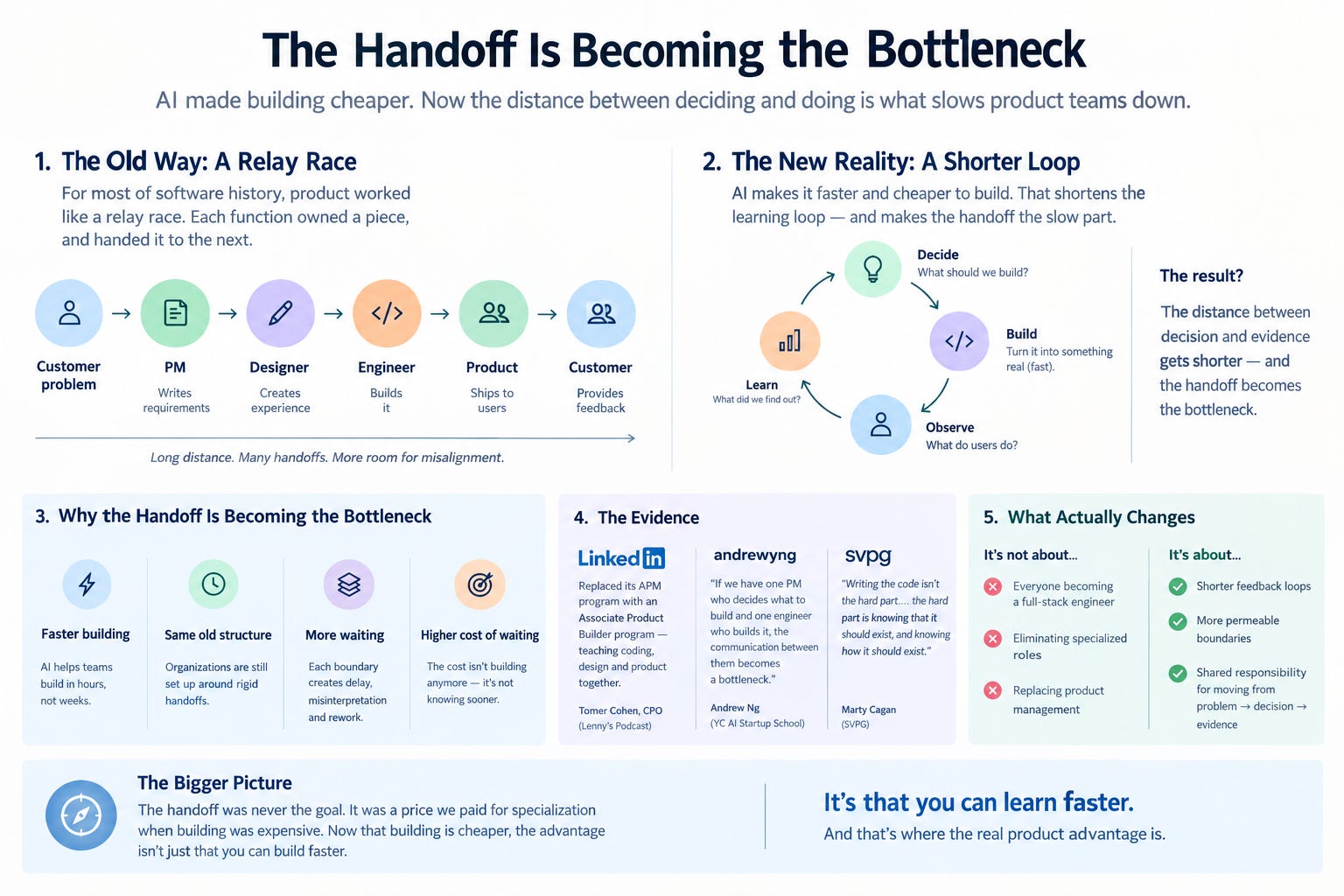
For most of software history, product development worked like a relay race.
The PM figured out what to build.
The designer figured out what it should look like.
The engineer figured out how to make it work.
Then someone handed the baton to the next person.
That structure made sense.
Software was expensive to build. Engineering time was scarce. Before asking a team to spend weeks or months building something, you wanted the problem understood, the requirements documented, the design reviewed, and everyone aligned on what was supposed to happen.
The handoff was a feature.
AI is making that handoff look more like a bottleneck.
Not because PMs are becoming engineers.
Not because engineers are becoming PMs.
But because the distance between deciding and doing is becoming increasingly expensive in a world where building itself is getting cheaper.
And some of the smartest product organizations are already changing around that reality.
The Software Relay Race
The traditional product process looked something like this:
Customer problem → PM → PRD → Designer → Design → Engineer → Code → Product → Customer
Every handoff existed for a reason.
The PM needed to communicate intent. The designer needed to translate that intent into an experience. The engineer needed to translate the experience into a working system.
The problem wasn’t that any individual step was bad.
The problem was the distance.
By the time the person who made the original decision saw the product working, weeks or months could have passed. Every handoff introduced another opportunity for interpretation. A requirement that seemed obvious to the PM wasn’t obvious to the engineer. An interaction that looked clean in Figma felt awkward in the actual product. A workflow that everyone approved in a meeting suddenly felt wrong when a customer tried it.
For decades, we accepted this because the alternative was expensive. You couldn’t easily build five versions of an idea just to discover which one made sense. So you tried to communicate the answer as precisely as possible before anyone built it. That’s one reason the PRD became so valuable.
But the economics are changing.
As I argued in the last issue, AI is making prototypes dramatically cheaper. A PM can increasingly turn an idea into something tangible without assembling an entire delivery team first.
The prototype becomes part of discovery.
And once that happens, something else becomes visible:
The handoff was partly a consequence of the cost of building.
When Building Gets Cheap, Handoffs Get Expensive
Imagine two product teams.
Team A:
PM → requirements → design → engineering → implementation → feedback
Team B:
Problem → decision → prototype → user → evidence → decision
Team B isn’t eliminating design or engineering. It isn’t suggesting that everyone should become a full-stack developer. It’s doing something more important: shortening the distance between a product decision and evidence about that decision.
AI doesn’t eliminate the need for specialized expertise. It changes how much work needs to wait for another function before it can move.
And that is already showing up in how companies think about product roles.
Andrew Ng: The Bottleneck Moved
Andrew Ng described this shift directly in a post that became one of the most discussed observations in product circles this year.
In AI-native teams, engineers are using coding agents to build products much faster than before. Some are taking on more product and design responsibilities. Small teams working in close proximity can move incredibly quickly.
But Ng points out that faster building creates a different constraint:
“Because we can now build fast, a greater fraction of time must be spent deciding what to build.”
He goes further:
“If we have one PM who decides what to build and one engineer who builds it, the communication between them becomes a bottleneck.”
That’s a striking reversal.
For years, we worried about engineering being the bottleneck. Now imagine engineering output accelerating dramatically while the decision-making process remains organized around the old ratio.
The team can build faster. But the PM still has to decide what to build. The engineer still has to wait for enough clarity to act. The PM still has to wait for enough engineering capacity to learn whether the idea works.
The bottleneck hasn’t disappeared.
It moved.
And once the cost of building falls, the cost of waiting becomes much easier to see.
Ng’s conclusion: “The fastest-moving teams I see tend to have engineers who know how to do some product work and, optionally, some PMs who know how to do some engineering work. When an engineer understands users and can make decisions on what to build and build it directly, they can execute incredibly quickly.”
He is not arguing that engineers should absorb product management. He is arguing that the rigid boundary between the two is slowing teams down.
LinkedIn Is Already Experimenting With the Boundary
LinkedIn’s response is even more concrete.
The company replaced its Associate Product Manager program — one of the most respected APM pipelines in the industry — with an Associate Product Builder program. The new program brings coding, design, and product management together rather than treating them as separate stages of a career.
LinkedIn’s CPO Tomer Cohen also introduced a Full-Stack Builder path designed around taking an idea from zero to one with AI.
And the hiring process reflects the philosophy. Instead of asking candidates to describe what they have done, candidates submit a working product. The final interview involves building something end to end in real time.
The signal isn’t: can you talk about product?
It’s: can you take an idea and make something real?
That doesn’t mean LinkedIn has decided everyone should become an engineer. It means the company is experimenting with a different unit of work.
Instead of: one person decides, another designs, another builds.
The emerging model: a small group of people can take an idea from problem to working evidence.
What actually separated great candidates from good ones in the new process? Not their tooling. Their judgment.
The Handoff Was Never the Valuable Part
This is where Marty Cagan’s argument becomes important.
At first glance, Cagan sounds like the counterargument. PMs aren’t going away. Discovery still matters. Product judgment still matters.
He’s right. But his actual argument is more interesting than simply saying “don’t worry, PMs are safe.”
In his August 2026 piece drawing on technology analyst Benedict Evans, Cagan quotes Evans directly:
“Writing the code isn’t the hard part, and making the tool isn’t the hard part — the hard part is knowing that it should exist, and knowing how it should exist.”
That’s the part of product management that becomes more important when building gets cheaper.
Knowing which customer problem is actually worth solving. Recognizing the underlying problem behind an individual feature request. Finding a solution that works for real users. Understanding whether the solution works for the business. Knowing when the evidence says your original idea was wrong.
Those are not coordination tasks. They are judgment.
And that’s why Ng and Cagan are not describing opposing futures.
Ng is describing what happens to the handoff. Cagan is describing what remains valuable when the handoff becomes cheaper.
Put them together:
AI isn’t eliminating product management. It’s exposing which parts of product management were actually valuable.
I’ve Lived on Both Sides of the Handoff
This shift feels familiar to me.
I didn’t start my career in product management.
I spent years in technical support, working with enterprise customers when security products failed in production. Then I moved into solutions engineering, running demos and proofs of concept and working directly with customers to understand whether a product actually solved their problem. Eventually, I moved into product management.
The most valuable part of that journey wasn’t the change in title. It was the accumulation of context.
I had seen the customer problem. The technical reality. The product gap. The product decision.
I had already been living across boundaries before anyone called it an AI-native way of working.
And I think that’s what AI increasingly rewards — not people who know everything, but people who can carry enough context across boundaries that the work doesn’t have to stop at them.
This Does Not Mean Everyone Should Code
The easiest article to write about all of this would be: “PMs need to learn to code.”
I don’t think that’s the lesson.
Specialization still matters. You still need engineers who understand distributed systems, security, reliability, and production realities. You still need designers who understand interaction, accessibility, and human behavior. You still need product people who understand customers, markets, strategy, and business viability.
The difference is that the edges are becoming more permeable.
A PM shouldn’t need to wait three weeks to discover that a workflow feels wrong. An engineer shouldn’t need to wait for a 12-page specification to notice that a proposed solution makes no sense. A designer shouldn’t need to wait for production engineering to explore every interaction.
Everyone can move a little closer to the work.
Less: “That’s not my function.”
More: “I can take this far enough to find out.”
The Paradox of Cheap Building
There is a trap here.
If AI makes building cheap, teams can also build too much.
The goal isn’t build everything. It’s build enough to learn.
That’s why this isn’t really an argument for PMs who code. It’s an argument for shorter learning loops.
When building was expensive, the organization naturally constrained experimentation. When building becomes cheap, that constraint weakens. Now something else has to provide it.
Judgment.
Which idea is worth testing? What question are we actually trying to answer? What evidence would change our mind? When should the prototype be thrown away? When should it become a product?
The danger isn’t that AI lets us build the wrong thing. We’ve always been able to do that. The danger is that AI lets us build the wrong thing much faster.
So the scarce skill isn’t simply building. It’s knowing what deserves to be built.
What Happens to the PM?
If PMs aren’t primarily there to write requirements, coordinate handoffs, maintain backlogs, and translate information between functions, what exactly are they there to do?
Move upstream and downstream at the same time.
Upstream: what should exist?
Downstream: does what we built actually work?
In between: what can we build quickly enough to find out?
The PM becomes less of a relay runner and more of a connector between problem, decision, build, and evidence.
That requires more product judgment, not less. More technical fluency, not necessarily more coding expertise. More customer proximity. More comfort with ambiguity. And much less attachment to the idea that your job ends where someone else’s begins.
The Handoff Was Never the Goal
The handoff was never the product. The outcome was.
We created specialized roles and handoffs because specialization was an efficient way to build software. And for a long time it was.
But organizational structures are responses to economic constraints. When the constraints change, the structure eventually changes too.
AI has changed one of the biggest constraints in software: the cost of turning an idea into something real.
That means we can ask a different question.
Not: who owns this step?
But: how quickly can the team move from uncertainty to evidence?
One Thing to Try This Week
Take one feature your team is currently discussing and spend one hour building the roughest possible version of the core interaction instead of writing requirements for it.
Then put it in front of one person who was not involved in creating it. Watch what they do. Don’t explain it. Don’t defend it. Just watch.
What you learn in that hour is the value of the shorter loop.
AI did not eliminate the need for PMs.
It did not eliminate the need for engineers.
It did not eliminate the need for designers.
It changed the economics that made their boundaries so rigid.
When building was expensive, specialization and handoffs helped us coordinate. When building gets cheap, those same handoffs can become friction.
The product teams that adapt won’t necessarily be the ones where everyone learns to code. They’ll be the ones where nobody is forced to stop at the edge of their job description just to move an idea forward.
The PM can build enough to learn. The engineer can shape enough to influence the product. The designer can explore enough to challenge the solution.
AI isn’t eliminating product management.
It’s eliminating the assumption that deciding and building have to be two separate jobs.
Because the advantage isn’t simply that you can build faster.
It’s that you can learn faster.
This Week’s Featured Job Openings
Company: PenLink
Location: Lincoln, NE
Company: Dropbox
Location: Remote, USA
Company: Rubrik
Location: Palo Alto, CA
Company: Gusto
Location: Multiple locations, USA
Director of Product Management
Company: Mastercard
Location: Multiple locations, USA
Stay tuned each week as we bring you new opportunities. Happy job hunting.
“The handoff was partly a consequence of the cost of building” stopped me.
When prototypes become cheap, the risk is no longer only a slow team. It is a team that can produce evidence faster than it can decide what evidence matters.
Have you seen a reliable way to keep “shorter learning loops” from turning into “more experiments, less judgment”?